Fill out Schedule D Form 1120 Online in 2026
Report your profits and losses from selling assets
Get Form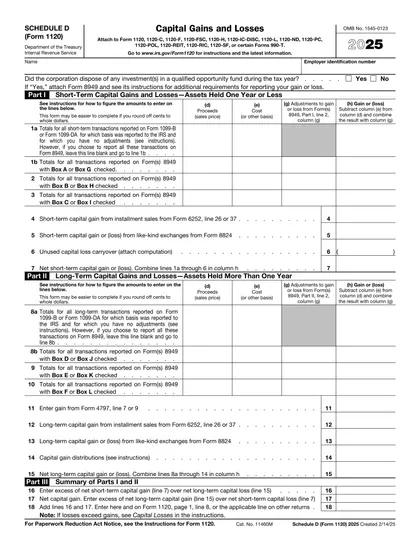
This site is not affiliated with any government, tax, or other official agency. Form last updated: 07/2026. Please verify you are using the current, correct version for your situation before submitting it.
How it works
1. Open the form
Access the pre-loaded form directly in our PDF editor. No need to upload anything!
2. Fill in your details
Carefully complete all required fields to ensure accuracy and validity.
3. Download as PDF
Save your filled-out form in PDF format, ready for submission or other needs.
What is Form 1120 Schedule D?
Schedule D (Form 1120) is used by corporations to report capital gains and losses from the sale of assets. Understanding this form is important because it helps determine the overall tax liability for a corporation. By accurately reporting these gains and losses, businesses can ensure they pay the correct amount of tax and avoid penalties. This form also provides valuable information for financial planning and investment decisions. Always refer to IRS guidelines for accurate completion.
What is Form 1120 Schedule D used for?
Schedule D (Form 1120) is used by corporations to report capital gains and losses. Here’s what it helps you do:
- to calculate total capital gains and losses.
- to report transactions involving stocks and bonds.
- to determine tax liability based on capital gains.
How to fill out Form 1120 Schedule D?
Gather all necessary documents, including records of gains and losses from sales of assets.
Enter your personal information at the top of the form, such as your name and tax identification number.
List each asset sold in the appropriate sections, including dates acquired and sold.
Calculate your total gains and losses, ensuring to distinguish between short-term and long-term.
Review your entries for accuracy and completeness before proceeding with your tax return.
Who is required to fill out Form 1120 Schedule D?
Corporations complete Schedule D Form 1120 to report capital gains and losses. This form is essential for tax calculations.
Tax professionals and corporate accountants use the form for accurate tax filing and compliance.
When is Form 1120 Schedule D not required?
If a corporation does not have any capital gains or losses during the tax year, it does not need to file Schedule D of Form 1120. Additionally, if the corporation's capital gains are fully offset by capital losses, or if it qualifies for certain exemptions, it might not be required to include this schedule.
Always check the IRS guidelines to ensure compliance with current regulations and requirements to determine if filing is necessary.
When is Form 1120 Schedule D due?
The deadline for Schedule D Form 1120, Capital Gains and Losses, is the same as the due date for the corporate income tax return, Form 1120. Typically, this is the 15th day of the fourth month after the end of your corporation's tax year.
For most corporations that operate on a calendar year, this means the deadline is April 15. If the due date falls on a weekend or holiday, the deadline is extended to the next business day.
How to get a blank Form 1120 Schedule D?
To get a blank Schedule D Form 1120, Capital Gains and Losses, visit our website. The form is pre-loaded in our editor, allowing you to fill it out directly. Once completed, you can download the form for your records.
Do you need to sign Form 1120 Schedule D?
Schedule D (Form 1120) does not require a signature according to the IRS guidelines. However, it’s important to verify this with the IRS for any recent updates.
Always check the IRS website to ensure you have the most current information. Being informed can help minimize any potential liability from misinformation.
Where to file Form 1120 Schedule D?
When filing Schedule D for Form 1120, you can submit it online through the IRS e-file system. This option allows for faster processing and confirmation.
Alternatively, you can mail the completed form to the appropriate IRS address. Make sure to send it well before the deadline to avoid any late penalties.