Fill out 1040 Schedule E Online in 2026
Report income or loss from rental and royalty properties
Get Form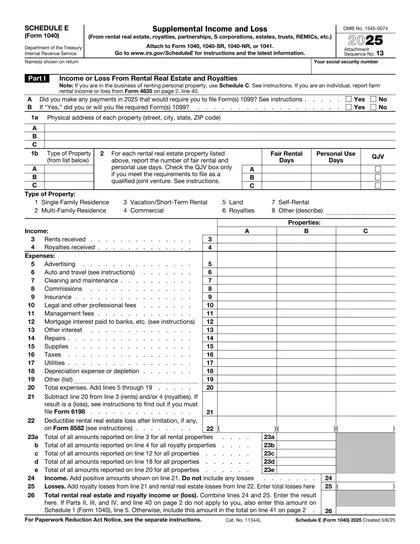
This site is not affiliated with any government, tax, or other official agency. Form last updated: 07/2026. Please verify you are using the current, correct version for your situation before submitting it.
How it works
1. Open the form
Access the pre-loaded form directly in our PDF editor. No need to upload anything!
2. Fill in your details
Carefully complete all required fields to ensure accuracy and validity.
3. Download as PDF
Save your filled-out form in PDF format, ready for submission or other needs.
What is Schedule E (Form 1040)?
Schedule E is used to report income or losses from rental real estate, partnerships, S corporations, estates, trusts, and more. It’s important because it helps you accurately calculate your taxable income from these sources. By filling out Schedule E, you ensure that you follow IRS rules and properly report your earnings, which can affect your overall tax bill. Understanding this form is key to managing your finances and avoiding potential penalties for incorrect reporting.
What is 1040 Schedule E used for?
Schedule E (Form 1040) is used for reporting supplemental income and loss:
- to report income from rental properties.
- to report income from partnerships and S corporations.
- to report income from estates and trusts.
- to report royalty income.
How to fill out IRS Schedule E, Form 1040?
Read the instructions for Schedule E carefully to understand what information is needed.
Gather all necessary documents, including income statements and expense records.
Fill out the sections for rental income, royalties, or partnerships as applicable.
Double-check your entries for accuracy and completeness.
Review any carryover losses or deductions.
Ensure all totals are correct before submitting the form.
Who is required to fill out Schedule E?
Individuals with rental income and partnerships complete Schedule E for reporting.
Taxpayers use the form later for income calculation and tax return filing.
When is Schedule E not required?
If you don't have income from rental real estate, royalties, partnerships, S corporations, estates, trusts, or residual interests in REMICs, you don't need to file Schedule E. Also, if your only income is from a job or you don't have any of the aforementioned sources, skip this form when filing your 1040.
Individuals who report income solely from wages or unemployment benefits are not required to include Schedule E. Keep in mind that if your situation changes, revisit this requirement in future tax years.
When is Schedule E due?
The deadline for Schedule E (Form 1040) is the same as the due date for your Form 1040, which is typically April 15. If this date falls on a weekend or holiday, you may file on the next business day.
If you need more time, you can file for an extension, but be aware that any taxes owed are still due by the original deadline to avoid penalties.
How to get a blank Schedule E?
To get a blank Schedule E, issued by IRS, simply visit our platform. The form is pre-loaded in our editor, allowing you to fill it out directly without needing to download a template from elsewhere. Once completed, you can download the form for your records.
Do you need to sign Schedule E?
You do not need to sign Schedule E (Form 1040) itself. According to the official IRS instructions and the form, Schedule E is attached to your Form 1040, which is the document that requires your signature.
Always stay updated on tax forms to avoid misinformation. Verification helps ensure you meet all requirements and reduce potential issues.
Where to file Schedule E?
You can file Schedule E online using e-file providers approved by the IRS. This method ensures faster processing and confirmation of receipt.
Alternatively, you can mail your completed Schedule E to the address specified in the IRS instructions. Make sure to use the correct mailing address based on your state.