Fill out K-1 Tax Form Online in 2026
Report your income from partnerships and S corporations accurately
Get Form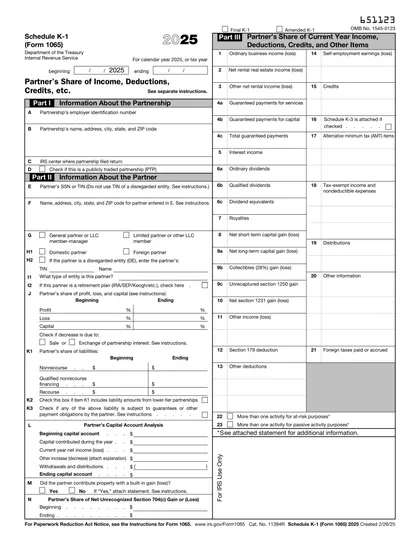
This site is not affiliated with any government, tax, or other official agency. Form last updated: 07/2026. Please verify you are using the current, correct version for your situation before submitting it.
How it works
1. Open the form
Access the pre-loaded form directly in our PDF editor. No need to upload anything!
2. Fill in your details
Carefully complete all required fields to ensure accuracy and validity.
3. Download as PDF
Save your filled-out form in PDF format, ready for submission or other needs.
What is a K-1 Tax Form?
The K-1 Tax Form is important for reporting income, deductions, and credits from partnerships, S corporations, estates, or trusts. It tells individual partners or shareholders how much money to report on their personal tax returns. Understanding your K-1 is crucial because it affects your overall tax bill and ensures you comply with IRS regulations. If you receive a K-1, make sure to review it carefully and include the information when filing your taxes to avoid issues with the IRS.
What is the K-1 Tax Form used for?
The K-1 Tax Form is used to report income, deductions, and credits from partnerships and S corporations:
- to inform partners or shareholders of their share of income.
- to help individuals report their tax responsibilities.
- to provide necessary details for accurate tax filing.
How to fill out the K-1 Tax Form?
Review the instructions for Form K-1 carefully to understand what information is needed.
Enter your partnership or S corporation name and employer identification number (EIN).
Fill in your personal information, including your name, address, and Social Security number.
Report your share of income, deductions, and credits in the respective boxes.
Double-check all entries for accuracy.
Save your work and prepare for submission based on IRS guidelines.
Who is required to fill out Tax Form K-1?
Partners in partnerships and shareholders in S corporations complete Form K-1 for tax reporting.
Taxpayers use the information on the form to report income on their individual tax returns.
When is the K-1 Tax Form not required?
You don’t need a K-1 Tax Form if you do not have income from partnerships, S corporations, estates, or trusts. Individuals who only receive wages or salaries from employment won’t receive this form.
If you are a member of a limited liability company (LLC) that is taxed as a sole proprietorship, you also won’t receive a K-1. Understanding these cases helps clarify your tax situation and avoid unnecessary paperwork.
When is K-1 Tax Form due?
The deadline for Form K-1 is March 15 for partnerships and S corporations. This form reports income, deductions, and credits from these entities to their partners or shareholders.
If you receive a K-1, make sure to include the information on your personal tax return. It’s important to file accurately and on time to avoid penalties.
How to get a blank K-1 Tax Form?
To get a blank K-1 Tax Form, issued by IRS, simply visit our platform. The form is pre-loaded in our editor, ready for you to fill out. Once completed, you can download the filled form for your records.
Do you need to sign Form K-1?
No, you do not need to sign Schedule K-1. The partnership return (Form 1065) as a whole must be signed by a partner or member, but individual Schedules K-1 do not require signatures.
Always check the IRS website for the most current information on tax forms. Staying informed helps you avoid potential issues with your filings.
Where to file Form K-1?
Form K-1 must be filed by mail with the IRS if you are a partner in a partnership or a shareholder in an S corporation.
Electronic filing is encouraged and can be done using IRS-approved software. Ensure all information is accurate before mailing to avoid delays in processing your tax return.