Pennsylvania Last Will and Testament Template
A fillable, printable Pennsylvania will template compliant with 20 Pa. C.S.A. § 2502
Get Form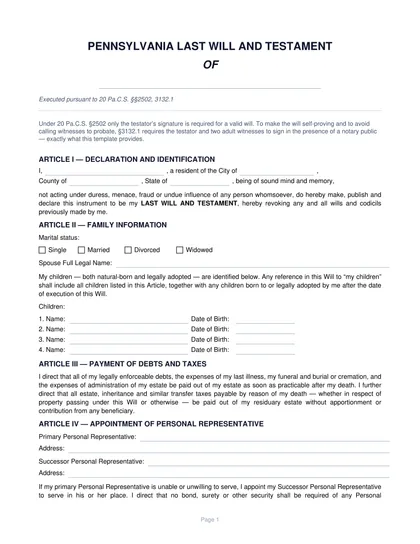
This site is not affiliated with any government, tax, or other official agency. Form last updated: 07/2026. Please verify you are using the current, correct version for your situation before submitting it.
How it works
1. Open the form
Access the pre-loaded form directly in our PDF editor. No need to upload anything!
2. Fill in your details
Carefully complete all required fields to ensure accuracy and validity.
3. Download as PDF
Save your filled-out form in PDF format, ready for submission or other needs.
What is a Pennsylvania Last Will and Testament?
A Pennsylvania Last Will and Testament is a legal document in which a person (the testator) sets out their wishes for the distribution of their assets and property after death. It names an executor (personal representative) to carry out those wishes, may designate guardians for minor children, and can include specific bequests to individuals, charities, or institutions. In Pennsylvania, wills are governed by 20 Pa. C.S.A. § 2502. Pennsylvania does not require witnesses for a will — only the testator's signature is mandated by statute. Including two witnesses and a notarized self-proving affidavit is strongly recommended to prevent challenges and simplify the probate process.
What is a Last Will and Testament used for?
A last will and testament serves several important purposes:
- Distribute property, bank accounts, and personal belongings to chosen heirs
- Name an executor to manage the estate and pay debts
- Designate a guardian for minor children
- Specify funeral or burial preferences
- Leave specific items or money to specific individuals or charities
- Create a testamentary trust to manage assets for minor beneficiaries
- Minimize disputes among surviving family members by clearly documenting intent Without a will, your state's intestacy laws determine who inherits — which may not reflect your wishes.
How to Fill Out a Pennsylvania Last Will and Testament
Enter your full legal name, date of birth, and address as the testator.
State that this document revokes all prior wills and codicils.
Name your executor and at least one alternate executor.
Name a guardian for any minor children, if applicable.
List your assets and designate who inherits each one.
Add specific bequests — particular items or amounts left to specific people.
Include a residuary clause to cover any assets not specifically mentioned.
Sign the will in the presence of your two witnesses.
Have both witnesses sign the will in your presence.
Optional: Have a notary administer a self-proving affidavit for a streamlined probate process.
Signing Requirements for a Pennsylvania Last Will and Testament
Pennsylvania is unique — under 20 Pa. C.S.A. § 2502, only the testator's signature is legally required for a valid will. However, two adult witnesses and a notarized self-proving affidavit are strongly recommended to protect against challenges and simplify the probate process. The testator must be at least 18 years old and of sound mind (testamentary capacity) at the time of signing.
Who Should Not Witness a Will?
A beneficiary named in the will, or the spouse of a beneficiary, should not serve as a witness — doing so can void their bequest or, in some states, invalidate the will entirely. A minor (typically under 18) cannot serve as a witness. Anyone with a direct financial interest in the estate — including the named executor if they are also a beneficiary — should be avoided as a witness. Choose two independent, disinterested adults to ensure the will's validity.
When Does a Last Will and Testament Take Effect?
A last will and testament takes effect only after the testator's death. During the testator's lifetime, the will can be changed or revoked at any time. After death, the executor must file the original will with the Register of Wills (Court of Common Pleas) in the county where the testator resided. The court opens a probate proceeding to validate the will, appoint the executor, and oversee asset distribution. Probate typically takes 6 months to 2 years depending on the estate's complexity and Pennsylvania court procedures.
Where Can I Get a Pennsylvania Last Will and Testament Template?
CookPDF provides a fillable, editable Pennsylvania Last Will and Testament template preloaded in the online editor. Open the custom template, complete all required fields, and download a printable PDF to sign with your witnesses. No software installation or account required to get started. You may also obtain will templates from your state's bar association, legal aid organizations, or estate planning attorneys — though a generic online template may not account for your specific circumstances.
How to Sign a Last Will and Testament Online
Important: A will must always be signed in person — electronic signatures are not legally valid for wills in most US states, including Pennsylvania. Use CookPDF to fill out and prepare your custom will template online, then print the completed document. Sign the printed will in the physical presence of your two witnesses. Both witnesses must also sign in your presence. If you are creating a self-proving will, have a notary public administer the affidavit oath and seal the document at the same signing session.
Where to File a Last Will and Testament
During your lifetime, store the original will in a secure location — a fireproof home safe, a safe deposit box, or with your estate planning attorney. In Pennsylvania, you may voluntarily file a copy with the Register of Wills (Court of Common Pleas) for safekeeping. After your death, the executor must file the original will with the Register of Wills (Court of Common Pleas) in the county where you resided. The court will open a probate proceeding to validate the will and authorize the executor to administer the estate.