This site is not affiliated with any government, tax, or other official agency. Form last updated: 07/2026. Please verify you are using the current, correct version for your situation before submitting it.
How it works
1. Open the form
Access the pre-loaded form directly in our PDF editor. No need to upload anything!
2. Fill in your details
Carefully complete all required fields to ensure accuracy and validity.
3. Download as PDF
Save your filled-out form in PDF format, ready for submission or other needs.
What is Form I-730?
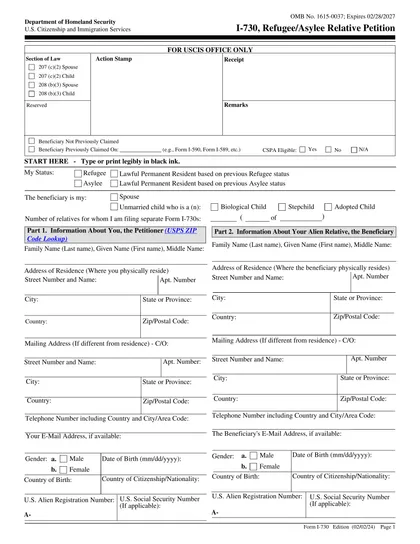
The Refugee/Asylee Relative Petition, known as Form I-730, is essential for individuals who have been granted asylum or refugee status in the United States. This form allows you to request that your spouse and unmarried children under 21 join you in the U.S. It plays a crucial role in reuniting families who have faced separation due to persecution or conflict, providing a pathway for them to live together safely and rebuild their lives. Understanding this form is key to navigating the immigration process successfully.
What is Form I-730 used for?
Form I-730 is important for bringing family members to the U.S. if you are a refugee or asylee. Here’s what you need to know:
- Purpose: Petitions for spouses or unmarried children under 21 to join you.
- Eligibility: Must have been granted asylum or refugee status within the last 2 years.
- Family Reunification: Helps reunite immediate family members.
- No Cost: Filing the form and scheduling an interview is free.
How to fill out Form I-730?
Enter your name, date of asylum grant, and details of previous marriages in the Petitioner Information section.
List each beneficiary's name, date of entry into the U.S., and details of any previous marriages.
Attach copies of I-94 entries and documentation showing how previous marriages ended.
Specify the relationship between you and the beneficiaries in the Petition Details section.
Download the completed form and file it with USCIS within two years of your asylum grant or refugee admission.
Who is required to fill out Form I-730?
Individuals who have been granted asylum or refugee status in the United States as the principal applicant are responsible for completing Form I-730. This includes those admitted as refugees in the last two years or granted asylum status.
Family members of the principal applicant, such as spouses and children, are required to use the form to seek to join their relative in the United States.
When is Form I-730 not required?
Form I-730 is not necessary for individuals without a qualifying family member, like parents or siblings. It's also not required for those who haven't been admitted to the U.S. as refugees or granted asylum. Additionally, if you're not petitioning for your spouse or unmarried children under 21, you do not need to file this form.
When is Form I-730 due?
The deadline for Form I-730 is within two years of when the petitioner was admitted to the United States as a refugee or granted asylum status. If there's a delay, USCIS may waive this deadline for humanitarian reasons, but a letter explaining the delay and supporting evidence must be provided.
How to get a blank Form I-730?
To get a blank Form I-730, simply visit our website. The U.S. Citizenship and Immigration Services (USCIS) issues this form, and we have a blank version pre-loaded in our editor for you to fill out. Remember, our platform aids in filling and downloading but does not support filing forms.
How to sign Form I-730?
To sign Form I-730, you need a handwritten signature, as USCIS does not accept stamped or typewritten names, nor electronic signatures. If cursive handwriting is not feasible, an "X" or similar mark is acceptable. After filling out the form using CookPDF, remember to check for the latest updates and ensure your signature meets the requirements before downloading, as CookPDF does not support submission.
Where to file Form I-730?
To submit Form I-730, send it by mail to the USCIS Texas Service Center. This change is effective as of January 1, 2023.
Remember, filing online is not an option for this form. Ensure it is correctly completed before mailing.